Vehicle Fitment Guide | Wheels, Tires & Suspension by Vehicle Make
Find vehicle-specific wheel, tire, and suspension fitment guidance for Ford, Chevy, GMC, Ram, Toyota, and Jeep. Contact Automotive Expressions today.
Vehicle Fitment Guide: Choosing Wheels, Tires & Suspension That Fit Right
Aftermarket wheels, tires, lift kits, leveling kits, lowering kits, and truck accessories can dramatically change how a vehicle looks and performs. But a successful upgrade begins with one requirement: correct fitment. Our Vehicle Fitment Guide helps you understand the key factors that determine whether aftermarket components will work properly with your specific vehicle.
A wheel may have the right finish and diameter but still be wrong for the vehicle if the bolt pattern, center bore, offset, backspacing, brake clearance, or load rating does not match. A tire may look perfect on a lifted truck but rub against a fender liner, bumper corner, control arm, or suspension component at full steering lock. A suspension lift may create more room for larger tires, but it can also change alignment angles, driveline geometry, steering behavior, and the clearance available through suspension travel.
At Automotive Expressions, we help drivers in Flowery Branch, GA, and across North Georgia plan custom wheel, tire, suspension, and accessory upgrades around their specific vehicles. Our team considers wheel size, tire size, offset, backspacing, clearance, load ratings, suspension configuration, and intended use so customers can pursue a build that looks right and performs the way they expect.
This Vehicle Fitment Guides hub provides a starting point for Ford, Chevrolet, GMC, Ram, Toyota, and Jeep owners. Use the guides to understand the questions that matter before purchasing aftermarket components, then contact Automotive Expressions for vehicle-specific recommendations and professional installation.
What Vehicle Fitment Means
Vehicle fitment is the process of confirming that an aftermarket wheel, tire, suspension component, or accessory is compatible with a particular vehicle. It is not limited to whether a part can physically be installed. Proper fitment also considers safety, clearance, performance, ride quality, load requirements, and the interaction between every modified component.
For wheels and tires, proper fitment includes much more than choosing a wheel that has the correct number of lug holes. A complete review should consider:
- Vehicle year, make, model, trim, drivetrain, and axle configuration
- Factory wheel and tire specifications
- Wheel bolt pattern
- Hub bore and hub-centric fitment
- Wheel diameter and width
- Wheel offset and backspacing
- Brake-caliper and brake-rotor clearance
- Tire diameter, width, sidewall, and approved wheel-width range
- Tire load index, load range, and speed rating
- Wheel load rating
- Fender, body, suspension, and steering clearance
- Factory or aftermarket suspension height
- Alignment requirements
- Towing, hauling, off-road, performance, or daily-driving use
A wheel-and-tire setup must also be evaluated in motion. Clearance while a vehicle is parked does not guarantee clearance at full steering lock, while the suspension compresses, during off-road articulation, or when a truck carries cargo or trailer tongue weight.
Automotive Expressions emphasizes this full-package approach because wheels, tires, suspension systems, and accessories affect one another. The shop helps customers evaluate sizing, wheel offset, available clearance, load ratings, suspension setup, and intended vehicle use before installation.
Why Correct Fitment Matters
Proper fitment helps protect your investment and supports safe, predictable vehicle operation. Incorrect parts selection can lead to tire rubbing, poor steering feel, vibration, uneven tire wear, damaged suspension components, reduced braking clearance, or a vehicle that does not perform as intended.
Common fitment problems include:
- Tires contacting fender liners, bumpers, valances, body mounts, or fenders
- Wheels rubbing brake calipers, control arms, shocks, struts, or steering components
- Incorrect wheel offset causing excessive tire protrusion or inner clearance issues
- Tires mounted on wheels outside the tire manufacturer’s approved width range
- Inadequate tire or wheel load ratings for towing, hauling, or work use
- Wheel vibration caused by improper hub fitment or incompatible hardware
- Rapid tire wear after lift, leveling, lowering, or suspension changes
- Brake-clearance issues after changing wheel diameter or spoke design
- Incorrect tire diameter affecting speedometer accuracy, gearing, and clearance
- Suspension geometry changes that affect handling and alignment capability
The correct fitment plan can also improve the finished appearance of a vehicle. It helps create a balanced stance, appropriate tire-to-fender spacing, practical wheel placement, and a complete wheel-and-tire package that matches the vehicle’s style and purpose.
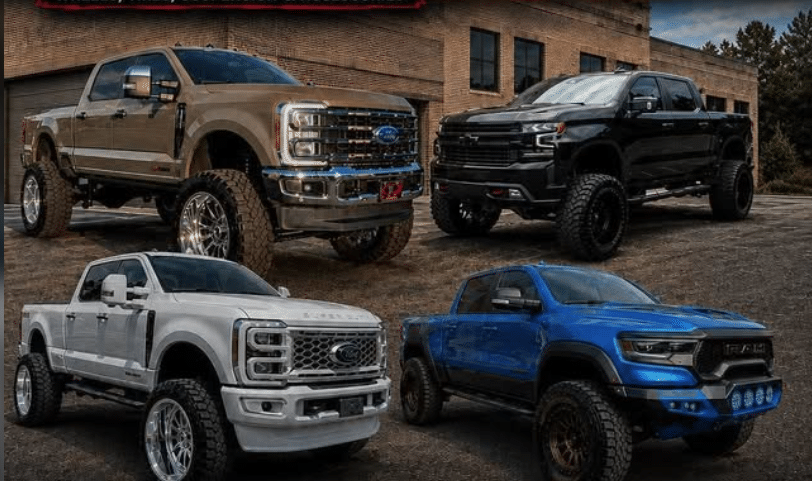
For example, a leveled Ford F-150 may benefit from a wheel-and-tire package that provides a more assertive stance without excessive tire poke or rubbing. A Jeep Wrangler built for trail use may need enough sidewall, steering clearance, and suspension travel for off-road conditions. A street-focused Chevrolet Silverado may prioritize a clean wheel fitment, refined tire choice, brake clearance, and daily-driving comfort.
Wheel Fitment Essentials
Wheels are one of the most visible upgrades available, but they must meet several specifications before they can be installed safely and correctly.
Bolt Pattern
The bolt pattern, sometimes called the lug pattern or pitch circle diameter, identifies how many lug holes a wheel has and the diameter of the circle they form. It is written in a format such as 6×135 mm or 6×139.7 mm.
A wheel must match the vehicle’s bolt pattern exactly. Similar-looking patterns are not interchangeable. For instance, a Ford F-150 commonly uses a different bolt pattern from a Chevrolet Silverado 1500 even though both are six-lug trucks.
Confirm the bolt pattern by exact vehicle year, make, model, trim, and axle configuration. Heavy-duty trucks often have different eight-lug patterns than half-ton versions of the same brand.
Center Bore and Hub Fitment
The center bore is the opening in the middle of the wheel that fits over the vehicle hub. A hub-centric wheel fits closely around the hub, helping center the wheel accurately.
Some aftermarket wheels use a larger center bore to fit multiple vehicle applications. In those cases, properly sized hub-centric rings may be required. The correct rings, compatible lug nuts, and proper installation procedures can help reduce vibration concerns and support secure wheel placement.
Wheel Diameter and Width
Wheel diameter determines the tire bead diameter needed for the wheel. Wheel width affects tire compatibility, sidewall shape, wheel appearance, and available clearance.
Larger wheels can create a bold look and may be required for certain brake packages. However, increasing wheel diameter often means using a lower-profile tire if overall tire diameter remains similar. This can affect ride comfort, pothole protection, tire availability, and wheel-and-tire weight.
Wheel width must be matched to the tire manufacturer’s approved range. A wider wheel can support a wider tire, but it also changes how the assembly sits under the vehicle and may create steering, suspension, or fender-clearance concerns.
Offset and Backspacing
Offset and backspacing determine the wheel’s position in relation to the hub, suspension, brakes, and fender.
- Offset is the relationship between the wheel-mounting pad and the wheel centerline.
- Backspacing is the distance from the mounting pad to the wheel’s inner edge.
A wheel with a lower or negative offset may push the tire outward and create a broader, more aggressive stance. That can be visually appealing on a truck, Jeep, or SUV, but it can also create rubbing, increase road-debris spray, and alter steering behavior. Too much inward placement can cause contact with brakes, control arms, shocks, struts, or steering hardware.
The correct offset depends on wheel width, tire size, ride height, alignment, suspension travel, and desired appearance.
Tire Fitment Essentials
Tires influence traction, handling, braking, ride quality, road noise, load capacity, ground clearance, and how the vehicle looks. Tire fitment begins with the sidewall size, but it does not end there.
A tire size such as:
275/65R20275/65R20
includes several measurements:
- 275 is the tire’s nominal section width in millimeters.
- 65 is the aspect ratio, meaning sidewall height is approximately 65% of the tire width.
- R indicates radial construction.
- 20 indicates the required wheel diameter in inches.
Actual tire dimensions can vary between brands and models. Two tires with the same advertised size may differ in overall height, width, shoulder shape, tread depth, weight, and clearance needs. This is especially important when selecting oversized all-terrain, hybrid-terrain, mud-terrain, or reinforced light-truck tires.
Tire Load and Speed Ratings
Tire load index is a numerical code that corresponds to the maximum weight one tire can carry at its specified inflation pressure. Speed rating is a letter code identifying the tire’s designed speed category under controlled conditions and proper loading.
These ratings matter for every vehicle, but they are especially important for:
- Trucks and SUVs used for towing or hauling
- Heavy-duty pickups
- Work vehicles
- Overland and off-road builds
- Vehicles with heavy aftermarket accessories
- Performance cars and SUVs
- Electric vehicles with higher curb weights
- Larger wheel-and-tire packages
A tire should meet or exceed the vehicle manufacturer’s requirements. Do not use a tire’s maximum sidewall pressure as the standard everyday inflation target. Instead, follow the cold tire-pressure recommendation on the vehicle’s door-jamb placard unless a qualified professional has provided an appropriate recommendation for an approved modified setup.
Tire Clearance
A tire needs sufficient space through its full range of movement. Check clearance:
- At full steering lock in both directions
- During normal suspension compression
- Around fenders, liners, bumpers, valances, and body mounts
- Around control arms, shocks, struts, brake components, and steering links
- Under cargo or towing load, if applicable
- During off-road articulation for trail-driven vehicles
A tire that clears in a showroom or driveway may rub on a speed bump, sharp turn, off-road obstacle, or loaded suspension. Professional fitment planning helps identify these issues before installation.
Suspension and Ride Height
Suspension changes play a major role in vehicle fitment. A lift kit, leveling kit, lowering kit, coilover system, replacement shocks, struts, or control arms can affect how much room is available for tires and how the vehicle handles.
Lift Kits
Lift kits raise ride height and may create space for larger tires. Depending on the vehicle and lift height, a system can include spacers, springs, shocks, struts, control arms, brackets, steering components, and other parts designed to maintain appropriate geometry.
Larger lifts may require closer attention to alignment, driveline angles, steering behavior, brake-line routing, shock travel, bump stops, control-arm angles, tire clearance, and wheel offset.
Leveling Kits
Many trucks leave the factory with the rear sitting higher than the front. A leveling kit raises the front to reduce this factory rake and create a more even stance.
Leveling kits can provide modest tire-clearance benefits and a clean visual upgrade, but they should be selected carefully for trucks that tow or haul. A leveled truck may sit differently with cargo in the bed or trailer tongue weight on the hitch.
Lowering Kits
Lowering kits reduce ride height and are common on street trucks, sports cars, muscle cars, and performance SUVs. A properly engineered system can create a lower stance and alter handling response, but excessive lowering can reduce suspension travel, cause tire rubbing, affect driveline angles, and create alignment limitations.
Every significant ride-height change should be followed by an alignment check. Camber, caster, and toe settings influence steering feel, directional stability, and tire wear. Incorrect toe can wear tires quickly, while excessive camber can wear tire edges.
Fitment by Vehicle Use
Vehicle use should guide your selection. A vehicle built primarily for its appearance may still need safe, functional fitment, while a work or trail vehicle needs components that support its real demands.
Vehicle Use |
Primary Fitment Priorities |
|
Daily driving |
Ride comfort, tire life, road noise, reliable clearance, practical wheel size |
|
Towing and hauling |
Tire and wheel load ratings, sidewall support, stable fitment, suspension condition |
|
Off-road driving |
Tire sidewall, trail clearance, steering range, suspension travel, wheel durability |
|
Overlanding |
Load capacity, accessory weight, tire construction, ride height, clearance under load |
|
Performance driving |
Wheel-and-tire weight, brake clearance, tire width, suspension setup, alignment |
|
Street or show build |
Stance, wheel design, offset, tire-to-fender clearance, practical drivability |
|
Winter use |
Tire category, wheel durability, seasonal tire fitment, proper inflation and tread condition |
Automotive Expressions offers custom wheels and tires, suspension upgrades, lift kits, lowering kits, bed covers, power steps, bolt-on accessories, and professional installation for a range of cars, trucks, and SUVs.
Vehicle Make Resources
Explore these make-specific fitment guides to learn more about wheel, tire, suspension, and accessory considerations for your vehicle.
- Ford Fitment Guide
- Chevrolet Fitment Guide
- GMC Fitment Guide
- Ram Fitment Guide
- Toyota Fitment Guide
- Jeep Fitment Guide
Get Fitment Help in North Georgia
Vehicle fitment is the foundation of a successful custom upgrade. The right wheels, tires, suspension components, and accessories should fit your vehicle correctly, clear moving parts, support your intended use, and work together as a complete package. Our Vehicle Fitment Guide provides helpful information to help you understand wheel fitment, tire sizing, suspension clearance, and other important considerations before choosing aftermarket components.