Lift Kits vs. Leveling Kits: Which Is Right for Your Truck?
Compare lift kits vs. leveling kits to learn about cost, ride quality, tire fitment, ground clearance, and the best option for your truck.
Lift Kits vs. Leveling Kits: What's the Difference?
If you’re looking to change the stance, appearance, or capabilities of your truck, you’ve probably come across two popular options: lift kits and leveling kits.
While both can raise your truck, they serve different purposes. A leveling kit is generally designed to reduce the factory rake of a truck by raising the front end, while a lift kit raises the vehicle’s suspension more substantially to provide additional ground clearance and accommodate larger tires.
Understanding the differences between lift kits vs. leveling kits can help you choose the right setup for your truck, driving habits, and budget.
At Automotive Expressions, we understand that a suspension upgrade is only one part of a complete truck build. Your lift or leveling kit should work with your wheels, tires, and overall vehicle setup to provide the fitment and performance you want.
What Is a Leveling Kit?
A leveling kit is designed to raise one end of a truck, typically the front, to reduce or eliminate the factory rake.
Many trucks are built with the rear sitting higher than the front. This design allows the vehicle to maintain a more level stance when carrying cargo or towing.
A leveling kit raises the front of the truck to create a more even appearance.
Depending on the vehicle, a leveling kit may use:
- Strut spacers
- Coil spring spacers
- Torsion keys
- Replacement springs
- Other suspension components
The exact design depends on the truck’s suspension system.
What Is a Lift Kit?
A lift kit raises the vehicle’s suspension to increase ride height and ground clearance.
Unlike a basic leveling kit, a suspension lift typically raises both the front and rear of the vehicle.
Lift kits are available in various heights, from mild lifts designed for street-driven trucks to larger systems intended for off-road use.
Depending on the lift, components may include:
- Springs
- Shocks
- Control arms
- Track bars
- Drop brackets
- Steering components
- Sway bar components
The more substantial the lift, the more important it becomes to maintain proper suspension and steering geometry.
Lift Kits vs. Leveling Kits: At a Glance
Feature |
Leveling Kit |
Lift Kit |
| Primary purpose | Level the truck’s stance | Raise the vehicle |
| Typical lift | Mild front lift | Varies from mild to substantial |
| Ground clearance | Limited increase | Greater potential increase |
| Larger tire fitment | May allow somewhat larger tires | Often allows significantly larger tires |
| Cost | Generally lower | Generally higher |
| Installation | Often simpler | May be more complex |
| Ride quality | Usually maintains factory characteristics | Can change depending on components |
| Off-road capability | Some improvement | Greater potential improvement |
| Suspension modifications | Usually fewer | Often more extensive |
The right choice depends on what you want to accomplish with your truck.
What Is the Main Difference Between a Lift Kit and Leveling Kit?
The primary difference is the amount and location of the lift.
A leveling kit typically raises the front of the truck to create a more balanced stance.
A lift kit generally raises the entire vehicle to provide additional ride height and clearance.
If your main goal is improving your truck’s appearance and fitting slightly larger tires, a leveling kit may be enough.
If you want substantially more ground clearance, larger tires, and greater off-road capability, a suspension lift may be the better option.
Which Is Better: A Lift Kit or Leveling Kit?
Neither option is universally better.
The best choice depends on your goals.
A leveling kit may be the better option if you:
- Want a more level stance
- Prefer a smaller modification
- Want to maintain much of the factory ride
- Plan to install moderately larger tires
- Have a smaller budget
A lift kit may be better if you:
- Want more ground clearance
- Plan to install larger tires
- Drive off-road frequently
- Want a taller stance
- Need additional suspension travel
- Want a more substantial truck build
Consider how you use your truck before choosing.
Lift Kit vs. Leveling Kit for Tire Size
One of the biggest reasons truck owners upgrade their suspension is to fit larger tires.
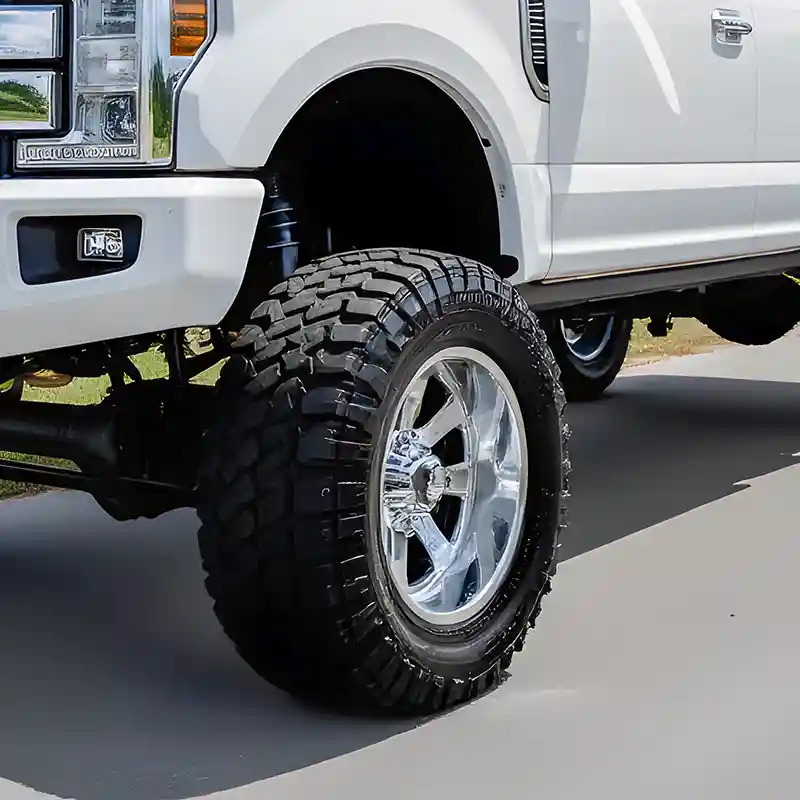
A leveling kit may provide additional clearance for a moderately larger tire, depending on the truck and wheel and tire combination.
A larger lift can create more room for significantly larger tires.
However, lift height isn’t the only factor that determines tire fitment.
You also need to consider:
- Tire diameter
- Tire width
- Wheel width
- Wheel offset
- Backspacing
- Suspension travel
- Fender clearance
- Steering clearance
A taller lift does not automatically mean any tire will fit.
The complete wheel and tire setup should be considered before purchasing a lift or leveling kit.
Can I Put Larger Tires on a Truck With a Leveling Kit?
In many cases, yes.
A leveling kit can create additional space in the front wheel wells, allowing some trucks to accommodate larger tires.
However, the specific tire size that will fit depends on the truck’s design and wheel setup.
A wider tire may still rub against suspension components or the fender liner, even after leveling the truck.
The wheel’s offset and backspacing can have a significant effect on clearance.
Can I Put Larger Tires on a Truck With a Lift Kit?
A lift kit generally provides more room for larger tires than a leveling kit.
However, tire fitment still depends on several factors.
A larger tire may rub during:
- Full steering lock
- Suspension compression
- Off-road articulation
- Cornering
- Driving over bumps
Before installing larger tires, verify the complete fitment rather than assuming that the lift height alone determines what will fit.
Lift Kits vs. Leveling Kits for Off-Roading
If off-road performance is a priority, a suspension lift generally provides more benefits than a basic leveling kit.
A lift can provide additional clearance and allow the use of larger tires, which may help the vehicle navigate rough terrain.
Depending on the suspension system, a quality lift kit may also improve:
- Ground clearance
- Suspension travel
- Wheel articulation
- Approach angles
- Departure angles
However, a lift kit isn’t the only factor in off-road performance.
Tire selection, traction, suspension travel, gearing, and vehicle configuration all play important roles.
Lift Kits vs. Leveling Kits for Daily Driving
For a truck that is primarily used as a daily driver, a leveling kit may provide the appearance you’re looking for without making extensive changes to the suspension.
A quality leveling kit can provide a more aggressive stance while maintaining much of the vehicle’s original driving characteristics.
A lift kit can also be suitable for a daily driver, particularly when the lift height and components are selected carefully.
However, larger lifts may change:
- Ride quality
- Steering feel
- Handling
- Center of gravity
- Fuel economy
- Entry and exit height
If your truck spends most of its time on the road, consider whether you actually need the additional lift.
Lift Kits vs. Leveling Kits and Ride Quality
A leveling kit often has less impact on ride quality than a larger suspension lift, but this depends on the design.
Some leveling kits use spacers that can change suspension travel or alter the relationship between suspension components.
A suspension lift may involve replacing factory springs and shocks, which can create a noticeable difference in ride quality.
The components you choose matter.
Quality shocks, properly matched springs, and appropriate suspension geometry can help maintain a controlled and comfortable ride.
Do Lift Kits and Leveling Kits Affect Alignment?
Both lift kits and leveling kits can potentially affect alignment.
Changing the ride height can alter:
- Camber
- Caster
- Toe
- Steering geometry
After installing either type of suspension modification, it is generally a good idea to have the alignment checked.
An alignment can help identify issues that may contribute to:
- Uneven tire wear
- Steering problems
- Vehicle pulling
- Off-center steering wheel
- Poor tracking
Do Lift Kits and Leveling Kits Affect Steering?
They can.
Changing the suspension height can alter steering and suspension geometry.
Depending on the vehicle and modification, you may notice changes in:
- Steering response
- Steering effort
- Return-to-center behavior
- Tracking
- Turning characteristics
Larger lifts may require additional components to maintain appropriate steering geometry.
If your truck feels unusual after installing a lift or leveling kit, have the suspension and alignment inspected.
What Are the Pros and Cons of a Leveling Kit?
Pros
- More affordable than many lift kits
- Creates a more level stance
- May allow somewhat larger tires
- Generally simpler installation
- Maintains much of the factory appearance and driving characteristics
- Good option for daily-driven trucks
Cons
- Less ground clearance than a larger lift
- Limited tire-size increase
- May not provide the desired off-road capability
- Can still affect alignment and suspension geometry
What Are the Pros and Cons of a Lift Kit?
Pros
- Increased ride height
- More ground clearance
- Greater potential for larger tires
- Improved off-road capability
- More aggressive appearance
- Greater suspension customization options
Cons
- Higher cost
- More complex installation
- May change ride quality
- Can affect handling and steering
- May require additional suspension components
- Larger tires and wheels can increase overall vehicle costs
Which Is More Expensive: a Lift Kit or Leveling Kit?
In most cases, a leveling kit is less expensive than a full suspension lift.
A leveling kit typically requires fewer components and less installation time.
The cost of a lift kit can vary significantly depending on:
- Lift height
- Vehicle
- Suspension design
- Brand
- Component quality
- Installation requirements
Additional costs may include new wheels, larger tires, alignment, upgraded steering components, and other modifications.
When budgeting for a lift, consider the entire build rather than just the cost of the lift kit itself.
Can I Install a Lift Kit or Leveling Kit Myself?
Some leveling kits are relatively straightforward for experienced DIY enthusiasts with the right tools and mechanical knowledge.
More complex suspension lifts can require significantly more expertise.
Installation may involve working with:
- Springs
- Shocks
- Control arms
- Track bars
- Steering components
Because suspension and steering components are critical to vehicle safety, professional installation may be appropriate if you don’t have the necessary experience.
After installation, the vehicle should generally be inspected and aligned.
Common Mistakes When Choosing a Lift or Leveling Kit
One of the most common mistakes is choosing a lift based solely on appearance.
Before selecting a kit, consider:
- How you use your truck
- Desired tire size
- Wheel offset
- Backspacing
- Ride quality
- Towing and hauling needs
- Off-road requirements
- Budget
Another common mistake is assuming that a larger lift automatically solves tire rubbing.
Tire rubbing can be caused by wheel offset, tire width, steering angle, or suspension compression. The entire wheel and tire fitment needs to be considered.
Lift Kit or Leveling Kit: Which One Is Right for You?
The best option depends on what you want from your truck.
Choose a Leveling Kit If You Want:
- A more balanced stance
- A relatively simple modification
- A lower-cost upgrade
- Moderate tire-size increases
- A truck that remains primarily street driven
Choose a Lift Kit If You Want:
- More ground clearance
- Larger tires
- A taller overall stance
- Increased off-road capability
- A more extensive suspension upgrade
Neither option is inherently better. The right choice is the one that fits your vehicle and your intended use.
Get the Right Lift, Wheels, and Tires for Your Truck
When comparing lift kits vs. leveling kits, it’s important to look beyond the amount of lift.
The right suspension setup should work with your wheel diameter, tire size, wheel width, offset, and backspacing.
A properly matched combination can help provide the appearance, clearance, ride quality, and performance you’re looking for.
At Automotive Expressions, we understand that a successful truck build requires a complete approach to fitment. Whether you’re considering a leveling kit for a more aggressive stance or a full suspension lift for larger tires and off-road capability, the right components can make all the difference.
Contact Automotive Expressions to learn more about lift kits, leveling kits, wheels, tires, and complete truck fitment.
Frequently Asked Questions About Lift Kits vs. Leveling Kits
What is the difference between a lift kit and a leveling kit?
A leveling kit typically raises the front of a truck to reduce the factory rake. A lift kit generally raises the entire vehicle to increase ride height, ground clearance, and tire clearance.
Is a lift kit better than a leveling kit?
Not necessarily. A leveling kit may be better for someone who wants a more level stance and modest tire upgrade. A lift kit may be better for someone who wants more ground clearance, larger tires, or increased off-road capability.
Does a lift kit provide more ground clearance than a leveling kit?
Generally, yes. A suspension lift can increase ride height and provide more clearance, while a leveling kit primarily changes the front-to-rear stance.
Which is better for off-roading: a lift kit or leveling kit?
A lift kit is generally better suited for serious off-road use because it can provide additional clearance and accommodate larger tires. However, overall off-road performance also depends on tires, suspension travel, traction, and vehicle setup.
Which is better for daily driving?
A leveling kit may be a good choice for a daily-driven truck when the primary goal is improving appearance and achieving a more level stance. A properly selected lift kit can also work well for daily driving.
Do I need an alignment after installing a leveling kit?
It’s generally recommended to have the alignment checked after installing a leveling kit. Changing ride height can affect alignment angles and steering geometry.
Do lift kits affect ride quality?
They can. Ride quality may change depending on the lift height, suspension design, shocks, springs, wheels, and tires. A quality lift kit with properly matched components can help maintain a comfortable ride.
Can a leveling kit cause tire rubbing?
Yes. Although a leveling kit may create additional vertical clearance, tire rubbing can still occur due to tire width, wheel offset, backspacing, steering angle, or suspension compression.
How do I choose between a lift kit and leveling kit?
Consider your desired tire size, driving habits, off-road needs, budget, ride quality preferences, and desired appearance. Your wheel and tire fitment should also be considered before choosing a suspension upgrade.
Can Automotive Expressions help me choose the right setup?
Yes. Automotive Expressions can help you consider lift height, leveling options, wheel size, tire size, offset, backspacing, and overall fitment when planning a truck or SUV upgrade.