Jeep Fitment Guide | Wheels, Tires & Suspension
Explore our Jeep Fitment Guide for precise wheel, tire, and suspension recommendations for Wrangler (JK/JL), Gladiator (JT), and Grand Cherokee (XJ, ZJ/WJ, WK2, WL). Contact Automotive Expressions today.
Jeep Fitment Guide:Wheels, Tires & Suspension for Wrangler, Gladiator & Grand Cherokee
From trail-ready Wranglers and overland-built Gladiators to refined Grand Cherokee street setups, Jeep platforms accept a wide range of upgrades. Each generation, however, brings unique bolt patterns, center bores, brake clearances, offsets, and suspension geometry that determine what actually fits. The Jeep Fitment Guide equips you with model-specific data before you select wheels, tires, lifts, or accessories.
A wheel that bolts to a JL Wrangler won’t necessarily clear the calipers on a WK2 Grand Cherokee. A tire that stuffs cleanly on a leveled JT may rub at full lock on a stock-height JK. Grand Cherokee packages often demand tighter attention to offset, hub-centric fitment, and wheel barrel clearance than solid-axle Wranglers.
Proper fitment is the foundation of every build—wheels, tires, spacer lifts, long-arm kits, or coilovers. At Automotive Expressions, we guide Jeep owners in Flowery Branch, GA, and across North Georgia through complete, use-case-based planning. We evaluate diameter, width, bolt pattern, hub fit, offset/backspacing, brake and barrel clearance, tire size, load rating, ride height, articulation, and intended use—mall crawl, overland, or rock crawl. Automotive Expressions provides custom wheels and tires, lift kits, leveling kits, Jeep accessories, and professional installation for drivers throughout the northern Atlanta area.
Why Jeep Fitment Varies
Jeep models span solid-axle and independent-suspension platforms with different bolt patterns, center bores, offsets, brake package sizes, and suspension travel. Small differences—like hub bore or caliper size—can be the difference between a perfect fit and a rub at full stuff.
Common patterns include 5×127 mm (5×5) on JK/JL Wranglers and JT Gladiator, 5×114.3 mm (5×4.5) on XJ Cherokee and ZJ/WJ Grand Cherokee, and 5×127 mm on most WK2 Grand Cherokee trims. WL Grand Cherokee uses 5×127 mm but may require specific offsets and hub-centric rings due to brake and hub variations.
This is why wheels are never chosen on looks or lug count alone. Before purchasing aftermarket wheels, tires, or suspension components, verify:
- Exact vehicle year, model, trim, axle ratio, and brake package
- Wheel bolt pattern
- Center bore and hub-centric ring needs
- Lug thread size, seat type, and torque specification
- Wheel diameter and width
- Offset and backspacing (scrub radius impact)
- Brake-caliper and rotor barrel clearance
- Tire size and approved wheel-width range
- Tire load index, speed rating, and load range where applicable
- Wheel load rating
- Fender, suspension, and steering clearance at full lock and full stuff
- Factory or modified ride height and bump stop length
- Alignment requirements after lift or spacer install
- Intended use: street, overland, rock-crawl, or daily driving
Your Jeep’s Tire and Loading Information label on the driver-side door jamb provides the factory tire size and recommended cold inflation pressure. Many late-model Jeeps include TPMS alerts to help maintain correct pressure.
Wrangler & Gladiator Fitment Essentials
Wrangler JK/JL and Gladiator JT are the most customized Jeeps in North Georgia. Owners commonly install aftermarket wheels, all-terrains or mud-terrains, spacer or coil lifts, control arms, fender upgrades, steps, and armor to match daily driving, overland travel, or technical trails.
JK/JL Wrangler and JT Gladiator use a 5×127 mm (5×5) bolt pattern with a large hub bore. Brake packages vary by trim, and wheel barrel clearance must be confirmed—especially on Rubicon trims with larger calipers and rotors.
Wrangler/JT Wheels and Tires
Popular wheel diameters range from 17 to 20 inches, with 17-inch being the go-to for sidewall flex and off-road protection. Choose diameter based on brake clearance and intended terrain.
- 17-inch wheels maximize sidewall for grip and impact absorption; ideal for 33–37 inch tires when lift and bump stops are set correctly.
- 18-inch wheels balance on-road manners with A/T tire choices; common for 33–35 inch setups.
- 20-inch wheels are appearance-forward and reduce sidewall; use carefully if off-road airing-down is expected.
Offset/backspacing sets track width and affects scrub radius and steering load. For solid-axle Jeeps, moderate negative offset can clear control arms and sway-bar links, but too much poke increases fender contact, road spray, and bearing stress.
Lifts, Articulation & Clearance
Spacer lifts level the stance and fit mild tire upsizes; coil spring or long-arm kits improve travel and geometry. Tire fitment must be confirmed at full lock and full stuff. Consider bump stop extensions, high-clearance fenders, and proper steering stops to prevent rubbing.
General guidance: 33s can work at stock height with the right offset and minor trimming; 35s often need a 1.5–2.5 inch lift and bump stop tuning; 37s typically require geared axles, fender changes, and steering/brake clearance checks. Load ratings and pressures matter—upgrades don’t increase factory axle ratings. For towing with JT, confirm wheel/tire load and appropriate E- or C-range tires based on GVWR.
Grand Cherokee Fitment
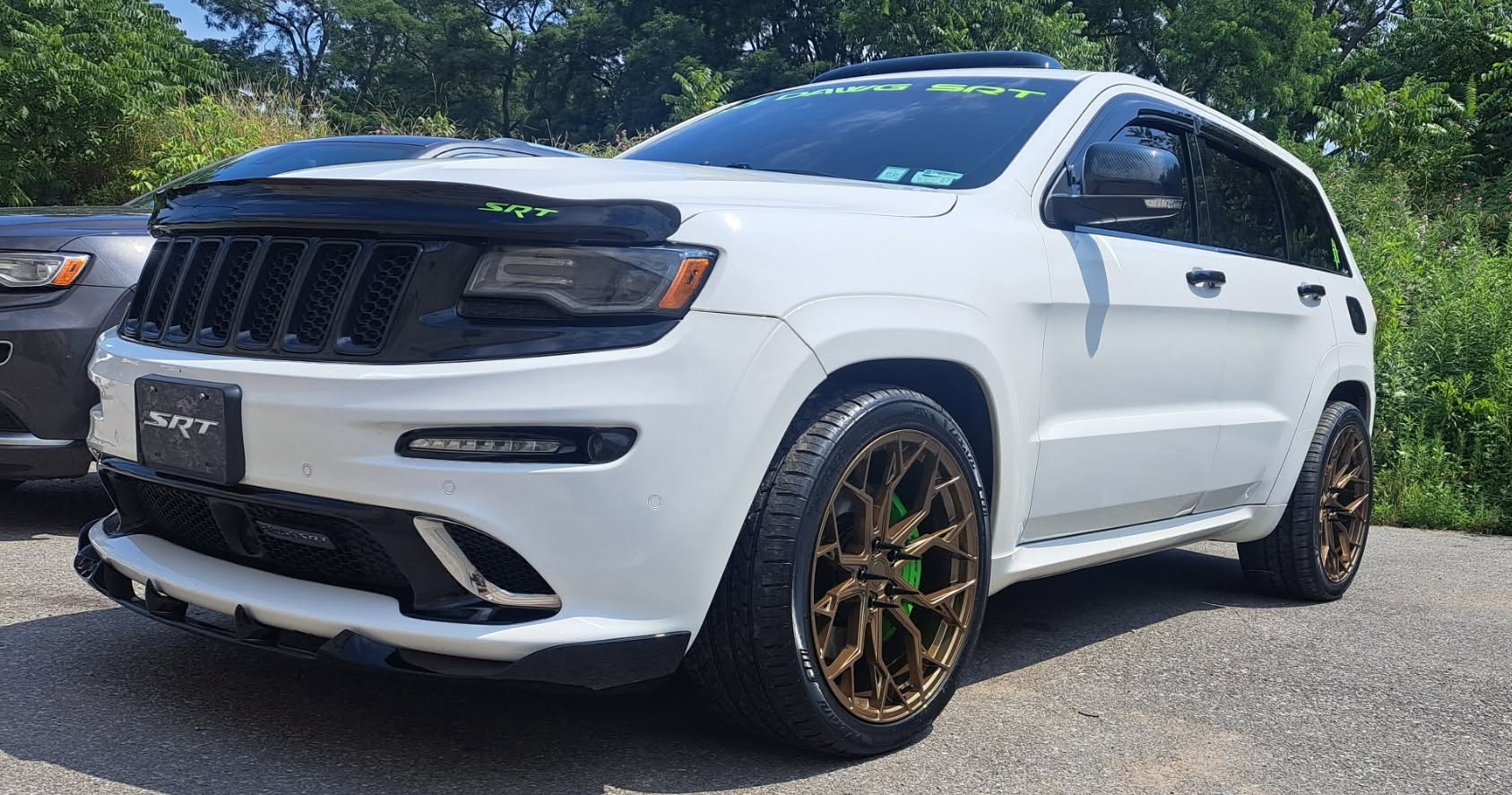
Grand Cherokee platforms balance daily comfort with trail capability. Wheel, tire, and suspension choices depend on generation and use—street performance, light overlanding, or snow and gravel travel. Precise offset and barrel clearance are critical on these SUVs due to larger brakes and tighter arches compared to Wranglers.
XJ and ZJ/WJ commonly use a 5×114.3 mm (5×4.5) pattern, while WK2 and WL move to 5×127 mm. Despite shared patterns with Wranglers, verify hub bore, offset, brake package, and load ratings before mixing wheels across models.
Grand Cherokee Wheel and Tire Priorities
Factory diameters typically range from 17–20 inches on WK2/WL, with performance variants using larger brakes that limit minimum wheel size. For mixed-use builds, 17–18 inch wheels paired with all-terrains offer sidewall and winter traction; 20 inch street packages emphasize handling and appearance but reduce off-road compliance.
When selecting a setup, consider:
- Passenger and cargo loads
- Occasional towing needs
- Tire load index and appropriate speed rating
- Wheel load rating and hub-centric fitment
- Road noise targets and ride comfort
- Seasonal weather and trail conditions
- Wheel weight and total rotational mass
- Ride height changes from spacer or spring lifts
- Clearance at lock-to-lock and during compression
Suspension & Geometry Notes
Mild spacer lifts can level stance and fit slightly taller tires, but alignment is essential afterward to maintain proper camber, caster, and toe. Changes in offset alter scrub radius, which can affect steering feel and stability. Address any rubbing, vibration, or pull immediately—hub-centric rings, correct torque, and retorque after 50–100 miles help prevent issues.
Jeep Wrangler & Gladiator Fitment Overview
Jeep platforms like the Wrangler (JK/JL) and Gladiator (JT) are built for customization, but correct fitment is what keeps them safe and trail-worthy. Daily commuters, weekend wheelers, and overland builds each demand different clearances, load indexes, and wheel geometries. Because Jeep suspensions articulate far more than typical SUVs, choices around wheel width, offset, and tire diameter directly affect rubbing, steering feel, and component life.
Most modern Wranglers and the Gladiator use a 5×127 mm (5×5) bolt pattern with a 71.5 mm center bore, while earlier Cherokee/XJ and Grand Cherokee ZJ/WJ commonly use 5×114.3 mm (5×4.5). Always verify the exact model, generation, brake package, wheel width, offset/backspacing, hub fitment, and load rating before purchase—small differences can determine whether a wheel clears the caliper or contacts at full stuff.
Street, Trail, and Overland Wheel/Tire Choices
For Jeeps that split time between commuting and weekend adventures, balanced ride quality and proper load capacity matter as much as looks. A correctly matched wheel and all-terrain tire provide sidewall for comfort, protect against potholes, and maintain safe geometry with factory steering.
A practical setup may include:
- A 17-inch or 18-inch wheel (common sizes that clear brakes and support usable sidewall)
- An all-terrain or hybrid-terrain tire for mixed use
- Adequate tire load index for passengers, gear, and accessories
- A wheel rated for off-road duty and vehicle weight
- Moderate negative offset/backspacing to preserve scrub radius and fender clearance
- Enough sidewall height for comfort, traction, and aired-down performance
For a more aggressive stance, larger-diameter wheels can be used, but be mindful that reduced sidewall compromises ride and off-road compliance. Don’t trade away load capability, tire strength, or articulation room simply to chase appearance—especially on Jeeps that see trails or carry overland cargo.
Load, Articulation, and Real-World Use
Jeeps often carry armor, recovery gear, rooftop tents, passengers, and camping supplies—all of which add weight that affects tire choice, inflation, and suspension behavior. Heavier builds can change how far tires tuck at full compression and during off-camber situations, which can introduce rubbing without proper bump stop tuning.
Avoid estimating capacity by multiplying a tire’s max load by four. Weight shifts forward under braking, to one side while turning, and to the rear with cargo—especially on off-road terrain. Follow Jeep’s GVWR, GAWR, payload, and wheel/tire limits, and ensure the lowest-rated component sets the boundary. Automotive Expressions can help validate your exact Jeep configuration so it performs predictably on the street and on the trail.
Jeep Bolt Patterns by Model
Jeep fitment varies widely across generations, so confirming your exact platform is essential before ordering wheels. Wrangler JK/JL and Gladiator JT share many fundamentals, but older Cherokee and various Grand Cherokee models use different bolt patterns and center bores. Brake package updates can also change barrel clearance requirements.
Common Jeep patterns include 5×127 mm (5×5) for Wrangler JK/JL and Gladiator JT, while XJ and many ZJ/WJ models use 5×114.3 mm (5×4.5). Grand Cherokee WK2 typically uses 5×127, and the newer WL family can vary. Because of these variations, never assume cross-compatibility across generations—verify bolt pattern, hub bore, offset, brake clearance, wheel width, and tire size before purchase.
Fitment Checklist for Wranglers, Gladiators, and Grand Cherokees
Seventeen-inch wheels are popular on solid-axle Jeeps because they balance brake clearance with sidewall for off-road traction. Eighteen-inch options can work for street-forward builds but reduce sidewall height. Match wheel width to tire manufacturer’s approved range and choose offsets that keep scrub radius in check.
For a Jeep wheel-and-tire package, verify:
- Model/generation and exact bolt pattern (JK/JL/JT 5×127; XJ/ZJ/WJ often 5×114.3; WK2/WL confirm)
- Center bore and hub-centric fitment (use hub-centric rings if needed)
- Wheel width matched to tire section width
- Offset and backspacing to protect steering geometry
- Caliper and rotor clearance in the wheel barrel
- Tire diameter and true measured height
- Upper control arm/knuckle, link, and sway-bar clearance at lock-to-lock
- Fender, flare, liner, and bumper clearance at full stuff
- Lift height (spacer, coil, or long-arm) and bump stop tuning
- Tire load rating relative to added armor and cargo
- Need for trimming or high-clearance fenders
Off-Road, Overland, and Daily-Driver Scenarios
Overland and trail builds add skid plates, steel bumpers, winches, racks, tents, and recovery gear—all of which increase weight and change suspension dynamics. A tire that clears at stock weight may rub when loaded, turned sharply, or articulating. Plan wheels, tires, suspension, bump stops, and intended cargo as a complete system.
Automotive Expressions can map out example fitments for mall-crawl stance, balanced overland travel, and rock-focused setups, ensuring your Jeep remains predictable from driveway to desert. If you need heavy-duty load insights for towing-focused builds, see our Ram Fitment Guide for general load rating principles.
Wheel Width, Offset, and Steering Geometry
Getting a Jeep’s wheel width and offset right is critical to handling, clearance, and component wear. On solid-axle Wranglers and the Gladiator, offset directly influences scrub radius—push wheels too far out and you’ll feel heavier steering, increased kickback, and added stress on ball joints and unit bearings. Too much inward offset risks inner-side rubbing on control arms and sway-bar links.
Wrangler JK/JL and Gladiator JT commonly run stagger-free (square) setups; the goal is proper width, backspacing, and tire diameter for your suspension height and travel. Grand Cherokee (WK2/WL) fitment must also factor larger factory brakes and independent front suspension dynamics that demand careful barrel and caliper clearance checks.
Choosing Sizes for Street, Overland, and Rock Use
Popular Jeep wheel diameters are 17 and 18 inches. Pair widths smartly with tire sizes: for example, 8.5–9 inches works well with many 285/70R17 or 35×12.50R17 options when offset keeps the tire centered in the wheel well. Backspacing around 4.5–5.0 inches is common on JK/JL/JT, but the correct choice depends on brake size, knuckle shape, and fender setup.
When planning, consider:
- Exact bolt pattern and center bore confirmation
- Wheel width matched to tire section width and approved range
- Offset/backspacing effects on scrub radius and tie-rod/knuckle clearance
- Brake rotor/caliper size and wheel barrel diameter
- Tire load index and speed rating appropriate for use
- Overall tire diameter versus lift height and bump stops
- Ride height and alignment targets (caster for stability, toe for tire life)
- Fender and flare clearance at lock-to-lock and full stuff
- Intended driving: mall-crawl stance, mixed overland, or technical rock crawling
Beadlock wheels excel at low pressures for rock crawling but add weight and may have TPMS or road legality considerations in some regions. Conventional wheels are lighter and often simpler for mixed-use rigs. Automotive Expressions can recommend options that balance strength, legality, and the way you actually drive.
Suspension Height, Tire Diameter, and Flex
Stock-height Wranglers typically fit ~33-inch tires with careful offset; 35s often need a small spacer lift and bump stop tuning; 37s generally call for proper lift, high-clearance fenders, and steering/axle upgrades. Long-arm systems increase articulation, making bump stop placement and fender clearance even more critical. Grand Cherokee WK2/WL platforms have tighter arches and larger brakes—confirm barrel clearance and consider mild lifts or trimming for larger diameters.
Proper torque and re-torque of lug nuts after installation helps prevent vibration and stud damage. After any change to wheels, tires, or suspension, schedule an alignment and a full lock-to-lock and full-stuff inspection. Automotive Expressions is here to blueprint your Jeep’s fitment so it drives straight on Monday and flexes cleanly on Saturday.
Jeep Fitment at a Glance
Jeep Platform |
Common Bolt Pattern |
Primary Fitment Priorities |
|
Wrangler JK (2007–2018) |
5×127 mm (5×5) |
Backspacing for 33–37″ tires, brake clearance, spacer vs. hub-centric fit, steering geometry |
|
Wrangler JL (2018–present) |
5×127 mm (5×5) |
Offset to manage scrub radius, high-clearance fenders, TPMS, 35–37″ tire fit at various lift heights |
|
Gladiator JT (2020–present) |
5×127 mm (5×5) |
Bed payload vs. tire weight, 35–37″ tire clearance, beadlock legality, alignment and caster |
|
Grand Cherokee WK2 (2011–2021) |
5×127 mm (5×5) |
Wheel barrel clearance for large brakes, air-suspension height modes, mild A/T fitment |
|
Grand Cherokee WL (2021–present) |
5×127 mm (5×5) |
Hub-centric fit, offset control for steering feel, tire diameter limits without rubbing |
|
Grand Cherokee WJ/ZJ (1993–2004) |
5×114.3 mm (5×4.5) |
Lift vs. driveshaft angles, backspacing for solid-axle articulation, bump stop tuning |
|
Cherokee XJ (1984–2001) |
5×114.3 mm (5×4.5) |
Narrow track width considerations, 31–33″ tire clearance, fender trimming, steering stop checks |
These references provide quick starting points for popular Jeep platforms. Exact specs vary by year, trim, axle, brake package, factory wheel size, and existing modifications. Always verify hub bore, brake dimensions, and suspension changes before ordering wheels or tires.
Get Jeep Fitment Help in North Georgia
The right Jeep wheel, tire, and suspension setup should match your platform and how you drive—daily commuting, overland travel, or rock crawling. The Jeep Fitment Guide from Automotive Expressions outlines model-specific details like bolt patterns, center bores, optimal offsets, and tire diameter limits at stock height, spacer lifts, and long-arm systems. A Wrangler built for trails has different priorities than a Grand Cherokee that splits duty between highways and forest roads.
Automotive Expressions is a local, family-owned wheel, tire, suspension, and truck-accessory shop in Flowery Branch, GA. We serve Jeep owners throughout Gainesville, Buford, Suwanee, Sugar Hill, Cumming, Duluth, Alpharetta, Johns Creek, Lawrenceville, and surrounding North Georgia communities.
Use the Jeep Fitment Guide to compare Wrangler JK/JL, Gladiator JT, Cherokee XJ, Grand Cherokee ZJ/WJ, WK2, and WL considerations—then contact Automotive Expressions to discuss Jeep wheel fitment, tire sizing, bolt patterns, wheel offset and backspacing, hub-centric rings, brake and barrel clearance, lift and leveling options, beadlock vs. conventional wheels, TPMS and road legality, and professional installation tailored to your Jeep.